
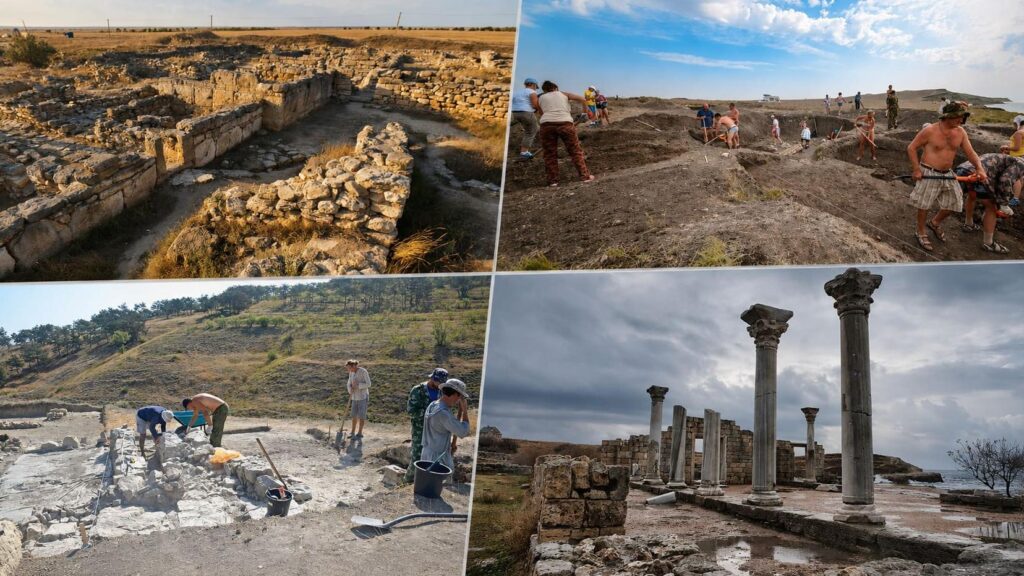
Ai generated image based on original photos of archeological sites located in the temporarily occupied Crimea
30 June 2026, 17:23
Field archeology of Crimea before 2014 and the start of occupation
With the outbreak of the Russian-Ukrainian war in 2014, academic researchers, including archaeologists, had to decide what to do with the projects located in the occupied territories. For Ukrainian researchers working in institutions legally based in Ukraine-controlled territory, as well as in those who happened to be based in the occupied territories, the issue was addressed in different ways, but the final decision was the same: there can be no joint projects with the occupiers. Some researchers left the occupied territories for Ukraine-controlled ones; the vast majority remained in place at least until the large-scale invasion, and there were those who left for Russia. Subsequently, the pathways of local researchers diverged: some accepted the offer to collaborate with the occupying authorities, while others refused. The vast majority of those who refused to collaborate with the occupiers had to leave the occupied territory, and there are those who were repressed by the occupying authorities.
Russian academic researchers, who had been working on joint projects with Ukrainians in the occupied territories prior to the occupation, considered the issue differently. The occupying authorities recognized them by default as the legitimate parties for these projects, while the Ukrainian party was simply expelled by the occupiers. The occupying authorities explained this saying that, allegedly, even before the occupation, these had been the Russian projects implemented jointly with Ukraine only de jure since Ukrainian legislation required it. The vast majority of Russian researchers agreed with this position of the Russian authorities, accepted the occupation, and thereby supported the occupying power’s actions. However, there were those who, as a matter of principle, refused to continue working in the occupied territories, there were also those who left Russia after the occupation of Crimea, as well as later, after the start of the full-scale invasion.
So, what fell under Ukraine’s jurisdiction in these joint projects? First and foremost, this was monitoring researchers’ compliance with Ukrainian heritage preservation laws, ensuring adherence to archaeological research methodologies, and supervising scientific reporting, including the transfer of collections found during excavations to Ukraine’s museum stock. In other words, it was Ukraine’s responsibility to ensure the high scientific quality of the research findings and the full transfer of artifacts to museums.
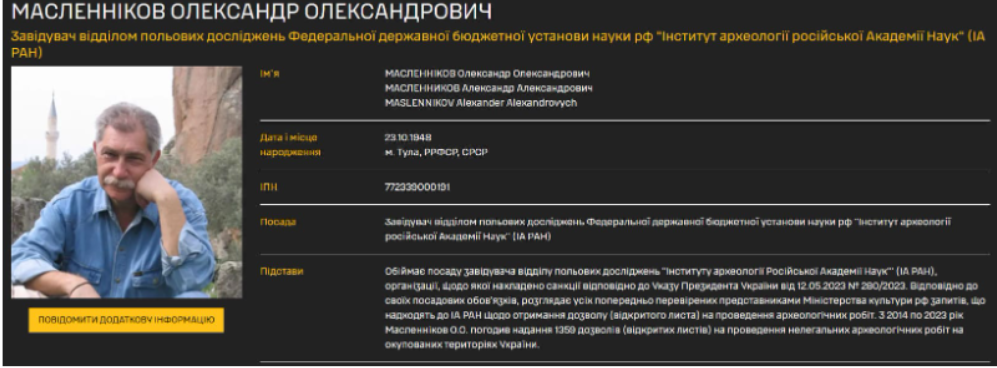
What are the differences between Ukraine’s and Russia’s requirements for archaeological excavations? As of 2014, Ukraine was one of the few post-Soviet countries that issued authorization documents (letters of authorization) through a scientific institution, namely the Institute for Archaeology of the National Academy of Sciences of Ukraine. In Russia at that time, these letters were issued by the Ministry of Culture. As noted at the time by Russian archaeologists, including Aleksandr Maslenikov, who headed and continues to head the Field Committee in Moscow, and with whom we communicated actively in Crimea, this transition adversely affected both the procedure for obtaining the letters and the quality of the works, subject to purely formal requirements.
In other words, Russia standardized the methodologies, excluding all science sensitive aspects, and then allowed excavations to be conducted not only by institutions with scientific archaeological departments and full-time staff, but also by non-governmental organizations, LLCs, and similar entities without any experience in such research. This resulted in a critical decline in the scientific quality of the research, which devolved into merely filling out report templates in accordance with standard requirements. At the time, Russian officials noted that reports submitted by a vast number of organizations in accordance with these standardized requirements were declared by reviewers to be non-compliant with established methodologies, and these institutions were prohibited from conducting further work. However, though such an institution ceased to exist, another would be created in its place, which would then receive another letter of authorization from the ministry. This entire procedure was generally aimed at destroying academic and university-based archaeological science in Russia, and indeed, this happened very quickly. Archaeology continued to exist in major museums such as the State Hermitage Museum, but there it came under the powerful top-down influence of the funding and management mechanism, and thus very quickly adopted the features required by the state machinery.
According to data reported in an interview with “Babel” by Nadiia Havryliuk, former head of the Field Committee of the Institute for Archaeology of the National Academy of Sciences of Ukraine, 12 Ukrainian-Russian archaeological expeditions, about 30 Ukrainian expeditions, and 1 Ukrainian-American expedition had been excavating in Crimea before 2014. The research conducted by both the Ukrainian-Russian and other international expeditions was purely scientific in nature, aimed at obtaining new scientific information. Preventive archaeological surveys (related to new construction and infrastructure projects) were carried out exclusively by Ukrainian institutions, and the land development rate in Crimea was not critically high, just as it was not throughout Ukraine.
Occupation
With over more than a decade of occupation passed, the Russian Ministry of Culture has issued 1,730 authorizations for archaeological fieldwork in Crimea, as reported by Daryna Pidhorna. The number of research projects has changed little compared to the pre-occupation period. But the preventive archaeology has increased tenfold, both in terms of the number of projects and the scope of work. Unprecedentedly numerous infrastructure projects, most of which were military construction or that related to military needs, featured the “Stakhanovite” work pace with a very low-quality standard. This situation was further exacerbated by the low scientific competence of the contractors, NGOs and LLCs, being issued letters of authorization for these studies en masse. The quality of work performed by research institutions and museums was also low due to a lack of experience of working in Crimea, unrealistically short deadlines, and the enormous scale of the projects. Furthermore, most big institutions were more interested in the huge sums of money they received for carrying out these projects than in the purpose of the work or the future of the archaeological sites and the artifacts uncovered during the excavations. As a result, hundreds of archaeological sites along the Tavrida Highway were destroyed, being simply demolished by bulldozers; and the southern suburbs of Chersonesus were razed to the ground.
In the first years following the occupation, the official heads of these institutions received letters of authorization (authorization documents) to perform research. When the first sanctions lists targeting Russian archaeologists and institutions carrying out illegal research in Crimea had been published, Russia began to change its approach to assigning responsibility for this work. In particular, the Hermitage ceased to be a contractor for the Russian Ministry of Defense in the “New Chersonesus” Archaeological Park project; the project’s management became part-time employees at the Institute of the Material Culture History of the Russian Academy of Sciences, which assumed responsibility for managing this work. A different approach was also adopted in selecting the work managers who are issued the letters of authorization .
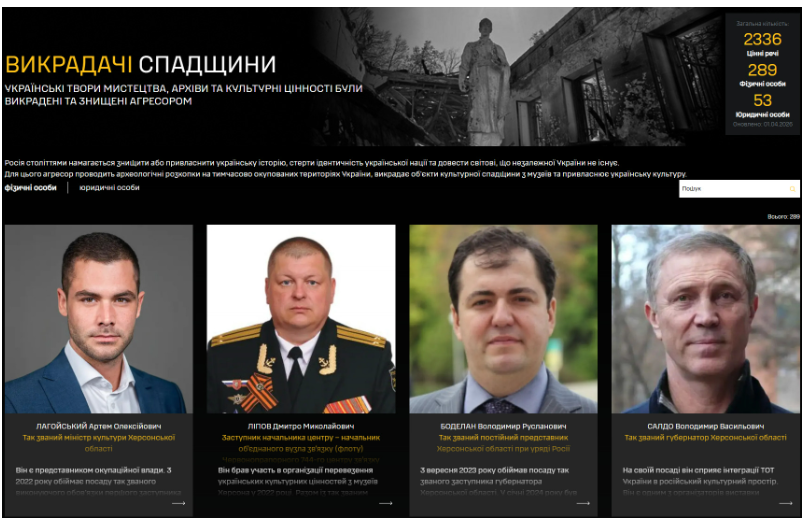
Researchers working on international projects were replaced by others who did not always hold academic degrees, did not claim to lead Russian projects, and did not have valid foreign grants. In this case, the Russians began actively engaging the Crimean archaeologists, granting them the right to obtain a letter of authorization. I should note that this right is a certain privilege in the post-Soviet archaeological research system.
A letter of authorization was introduced as an authorization document in the Russian Empire by the Imperial Archaeological Commission as far back as the 19th century. Initially, it was issued to researchers to monitor archaeological findings made on state-owned lands. According to the letter of authorization, the Imperial Commission received a report and selected excavated archaeological artifacts for further storage in the imperial museum, i.e. the Hermitage.
Excavations on land belonging to government agencies, such as the Black Sea Fleet, or on private land did not require the researcher to obtain an authorization letter. In the vast majority of cases, the findings belonged to the landowner. During the Soviet era, in addition to regulating the transfer of artifacts to permanent storage, the official authorization letter also served the mandatory function of ensuring the quality of archaeological research and verifying the researcher’s qualifications and excavation methods. In post-Soviet countries, it was quite difficult for a novice archaeologist to obtain an authorization letter. The reason for this was, first and foremost, the exceptionally closed nature of the archaeological academic community and its reluctance to admit outsiders. This led to significant problems in this field, ranging from classic corruption in the organizations that issued the letters, to the unofficial hierarchy of researchers: those who could obtain an authorization letter in their own name and those who had to make a deal with the so-called “holder” of the authorization letter. Sometimes these arrangements were purely collegial, intended to help a colleague by-pass the obstacles created by the Field Committees of institutions in post-Soviet countries.
But there were also cases when powerful officials from the institutions issuing the letters of authorization, forcibly “seized” grants, contracts, or simply promising projects. In fact, what happened in the Russian Federation, when Russian holders of authorization letters were replaced with Crimean ones, is one such example of manipulation. The privilege of obtaining a letter under sanctions turned into a threat. I won’t claim this for certain, but most likely the lists of those who would be issued authorization letters were compiled without taking into account the opinions of their holders. I found it particularly interesting that Vadim Maiko, director of the occupation-controlled Institute of Crimean Archaeology of the Russian Academy of Sciences, was exceptionally active in commenting on the Butyagin case, which was based on the lack of authorization documents. It is unlikely that he would have been entrusted with this “honorable role,” if he hadn’t been the person who may have been involved in compiling the lists of authorization letter holders.
Butyagin Case
Let’s focus directly on Butyagin’s case. Until 2014, he had worked exclusively on a joint project with a Ukrainian partner; it was Russia that issued him personally an authorization letter for Myrmekion. Furthermore, after the occupation, he began exploring another site – Kalos-Limen, an ancient Greek settlement of the outer Chersonesus Chora on Tarkhankut – as a part of Myrmekion expedition.
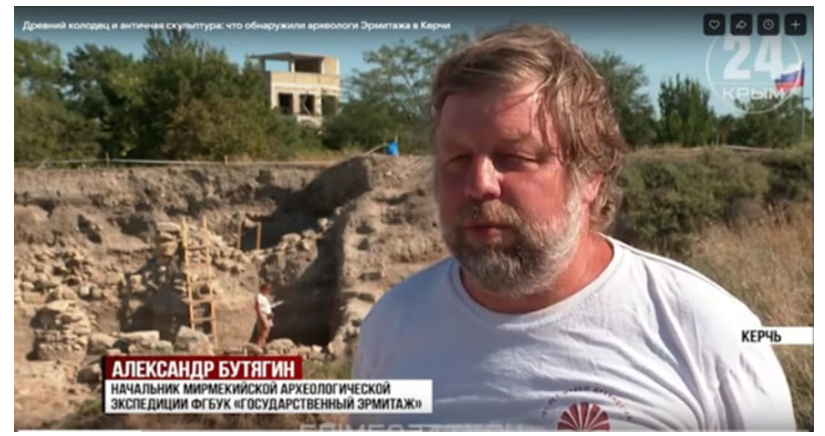
It is interesting to note that Aleksandr Butyagin had never worked in Chersonesus before, nor had he ever been interested in the archaeology of Western Crimea. In this context, his comments regarding the continuity of research on archaeological sites, a tradition among archaeologists, who would never agree to explore sites already being explored by another researcher, seem particularly noteworthy. That said, Kalos-Limen lost its nominal “holder” of the authorization letter with the death of Vadim Kutaisov. But it is also quite difficult to call Vadim Kutaisov a researcher of Kalos-Limen. When he was working there, he had very serious alcohol problems and was hardly in a state to conduct any research at all. The quality of that work is not the subject of this article, but I will note that the Institute for Archaeology of the National Academy of Sciences of Ukraine failed to resolve this issue and ended up simply transferring this expedition under administration of the Crimean Branch of the Institute for Archaeology of the National Academy of Sciences of Ukraine, and Vadim Kutaisov himself into its staff. I would like to emphasize that, for some reason, Vadim Maiko did not attempt to assign this extremely interesting site to any of the branch’s young researchers; instead, it was assigned for further research specifically to Aleksandr Butyagin.
Another interesting fact is Aleksandr Butyagin’s membership in the scientific advisory councils that provided methodological and scientific support for the “New Chersonesos” construction project. There, he represented the State Hermitage Museum.
“Holders” of authorization letter
Apart from Butyagin, Svitlana Adaksina kept on working in Chersonesus.
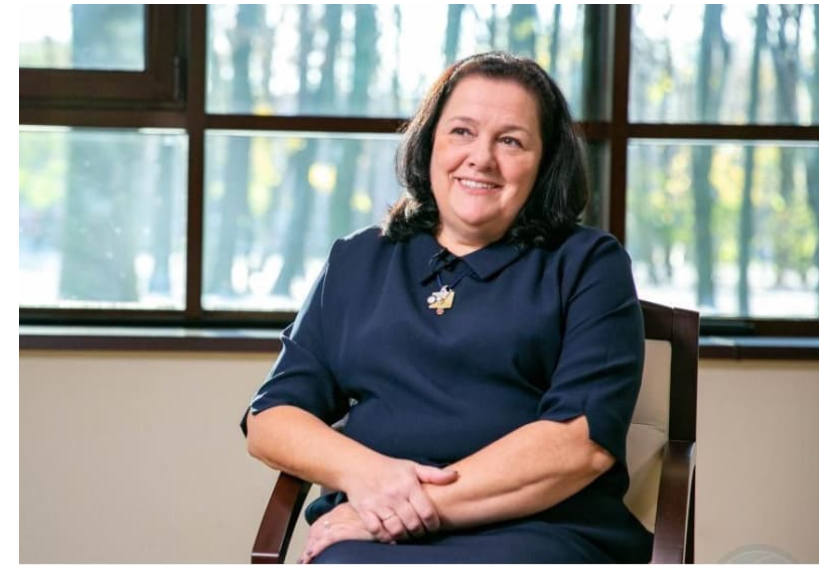
Before the occupation, she had been excavating at the Cembalo Fortress; with an authorization letter for this research being initially received by Viktor Myts, director of the Crimean Branch of the Institute for Archaeology of the National Academy of Sciences of Ukraine. After a series of criminal cases had been opened against him, Viktor Myts fled to St. Petersburg where he was immediately employed by the Hermitage. Then applications for these letters were placed by Serhii Ushakov, a staff member of the Crimean Branch of the Institute for Archaeology of the National Academy of Sciences of Ukraine. Sergey Solovyov, who supervised the notorious “excavations” in the southern suburbs of Chersonesus, is also an employee of the Hermitage. I should note that very few employees of the Chersonesus Museum who worked there before the occupation can be found on the list of holders of authorization letters for the excavations. This is primarily because most of the museum’s researchers were voluntarily or forcibly dismissed after the occupation. But even those who remained either are not trusted by the occupiers or refuse to become scapegoats, i.e. the “holders” of the Russian project’s authorizations in Crimea.
It is worth noting that, under the occupation, the Institute for Crimean Archaeology, a former Crimean Branch of the Institute for Archaeology of the National Academy of Sciences of Ukraine, began conducting archaeological surveys for new developments within the territory of the Sevastopol City Council. This institution had tried to enter this market for scientific services even before the occupation, but at that time it was not very successful, as it had to compete in a highly competitive environment. Both this branch and the Chersonesus Museum had been issued authorization letters for new development and other preventive archaeological surveys. Since at that time the museum had compiled the most comprehensive database of cultural heritage sites within the Sevastopol City Council’s jurisdiction, including their research status, distinguishing features, and other details, the Crimean Branch lost out to the museum in this competition. Now, as the documentation shows, this issue has been resolved by force: the Chersonesus Museum not only has stopped carrying out preventive research in Sevastopol but has also become unable to influence in any way the quality of this work or the urban development processes within the Chersonesus Chora and its surroundings, as well as the use of the lands belonging to its branches in Balaklava and Inkerman (Cembalo, Kalamita) and the surrounding areas in general. There is also a complete lack of data regarding the use of the plot on Inkerman Cape, i.e. the Uch-Bash settlement, which was designated shortly before the occupation as land for historical and cultural purposes and transferred for use to the “Chersonese Taurica” National Reserve. In fact, this territory used to be classified as “undivided”; the Russian military constantly laid claim to it, and this plot was never included in the annexes to the Russian-Ukrainian treaties. However, by its decision to allocate this plot of land for historical and cultural purposes, the Sevastopol City Council effectively recognized Ukraine’s jurisdiction over it.
Current Urban Development Processes in Sevastopol
Ultimately, all of this results not merely in negative trends in urban development – when the expansion of urban infrastructure harms cultural heritage – but completely undermines the city’s traditional development, transforming it into an urban project disconnected from both the past and even the present, as it is happening in Balaklava. The previous Russian project, “New Chersonesos,” is a manipulation of cultural heritage rather than adaptation. UNESCO status – regardless of how we may view its inaction today – nevertheless compelled the occupiers to take several steps that mimicked vigorous heritage preservation efforts. At that time, the idea of the “cradle of Russian Orthodoxy” in Chersonesus was promoted, and the physical remains of ancient Chersonesus were put at the service of this idea. The creation of the church-museum complex obliterated the museum complex of the ancient city of Chersonesus Taurica, which had been developed over more than a century. The church-and-museum complex, created to implement the “New Chersonesos” project, rolled back the status of the “Ancient City of Chersonesus Taurica and Its Chora” heritage site to that of the early 20th century, when there was a functioning monastery, and all actions related to the site were limited exclusively to conducting archaeological excavations without any museum-related development.
Current urban development processes in Crimea, as illustrated by Sevastopol, can be classified as “urban fascism,” in which all previous infrastructure, developed over several historical eras, is erased like a palimpsest, and an entirely new project is being created that ignores the historical development of the region and the population that developed it.
Archaeological studies, as evident now from the results of both scientific and preventive research, are part of a mechanism created by Russia to achieve this kind of obliteration. In this context, the explanations offered by Russian researchers who continue to work for the Russian government, that they are supposedly engaged in science and that this is “apolitical”, sound quite cynical. In reality, all Russians – both inside and outside Russia – are, to a greater or lesser extent, caught up in this “apolitical” stance. Very few Russians are currently taking a strongly antagonistic stance toward the Russian authorities.
Even more surprising is the widespread sympathy expressed by several scientific organizations in Europe toward Russian researchers who, as stated by a number of European academics, are being persecuted by the Ukrainian government. Archaeologists, more than anyone else, understand how the legacy of tradition – or lack thereof – manifests in urban space, where the continuity of development is evident in traditional urban planning and infrastructure, which may change technologically but remains unchanged in space planning. This is what serves as solid evidence of the continuity of a city’s or a country’s development – and, by extension, of the society that created them.
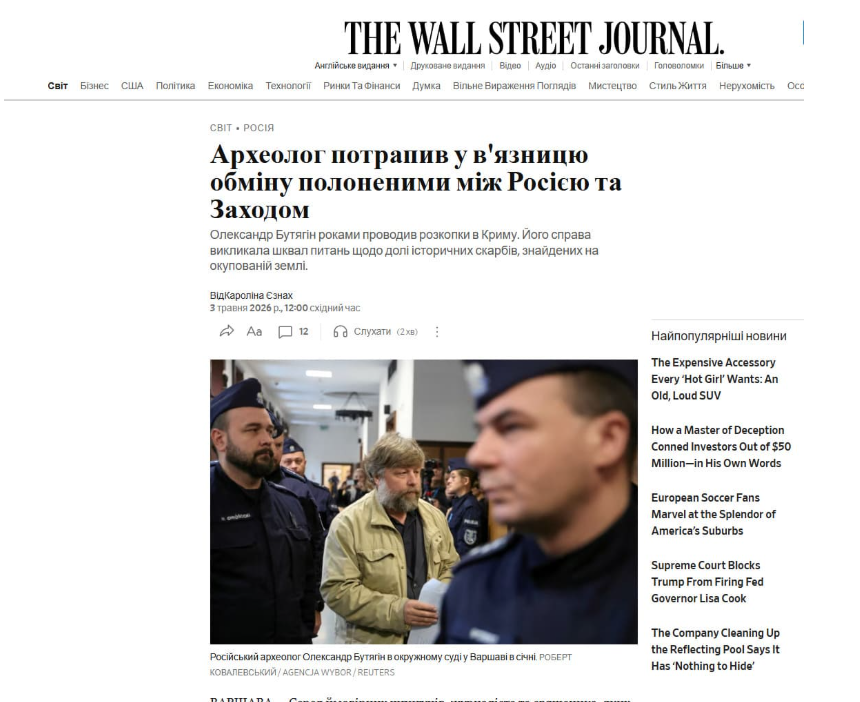
Are the occupying authorities aiming to destroy society by destroying its traditional infrastructure? This would indeed mark the end of the previous socio-economic system and the emergence of a new one. But whether the new system will function effectively is a major question that remains unanswered for now. The outcome of the Russian-Ukrainian war will provide the answer. Therefore, any scientific projects, if they take place during a war, cannot exist in isolation from it. The importance of the Hague Convention, which draws on the experience of 20th century wars and warns humanity against repeating the mistakes of the previous generations, only confirms the negative experience of Butyagin, who attempted to promote Russian science while working in the occupied territories.
“Expert’s” review reports
I would also like to highlight the examination of infrastructure and new development projects planned on the sites of archaeological monuments or in their immediate vicinity. In our understanding, a project examination is an assessment of its relevance to a cultural heritage site and a commented review of the proposed measures for its preservation and use – or, conversely, for its non-preservation, i.e., excavations. What is currently referred to as an “examination statement” in Russia can hardly be called an expert’s review report. It is a standard administrative form containing a uniform set of legal texts, subordinate acts, historical references, and texts that have the formal characteristics of assessing a particular conservation measure, etc., which together make up about 80% of the narrative. The rest consists of a general, non-detailed description of the measures taken to assess the archaeological situation; at best, it includes a table with the coordinates of the control points of the site where the monument is located and a short paragraph stating that measures to preserve the archaeological monument are feasible within the given project. This is the purpose of the examination.
These expert’s review reports sound extra cynical when the conclusion that the monument can be preserved is made while a permit has been issued to place major utility networks right through the cultural heritage site, or when it is clearly visible in a photo that an archaeologist with a surveying rod is standing on a section of the site that has been cut away in depth by several meters, and the edge of the cut rises spectacularly above his head. In other words, the archaeological surveys were conducted after a bulldozer had already driven over the construction site. Such photos can be found every second report, if not in everyone. The expert’s review report contains not a single word about violations of heritage protection laws at the site of the future project. In other words, the Russian system of examining the projects affecting cultural heritage sites is neither a commented review nor an assessment of the project’s relevance, but rather a step-by-step approval process for the construction project, which cannot contain any conclusion other than a positive one, supported by the cited excerpts from Russian laws and regulations. By the way, the expert’s work is not left without remuneration; it is a fairly profit-making business with an official salary. The Russian Federation has realized the dream of a disreputable developer by creating an official document that approves everything. The bribe for this approval is the official salary received by the expert for their work, with all taxes paid. It is no surprise that the surnames of the “experts”, for example, those responsible for Sevastopol’s archaeological heritage, are repeated: Yuriy Zaitsev, Igor Khrapunov, and Tatyana Sarapulkina. The latter is one of the new faces of Chersonesus, holding the position of deputy director for museum development and the protection of cultural heritage sites, while the first two have never worked either in Chersonesus or at Sevastopol’s historical sites.
At this point, it is difficult to say whether this is because none of the experts who had worked in Sevastopol prior to the occupation were willing to take on expert roles, or whether it is, once again, a deliberate expansion of Simferopol’s influence over southwestern Crimea, and Chersonesus in particular; a process that did not succeed before 2014, despite attempts made, but with the support of the Russian Federation, this field of expertise has been brought entirely under Simferopol’s control.
Of course, there is no reason to speak of Moscow’s respect for the status of the city of Sevastopol – quite the opposite, in fact. The influence of the Institute of Crimean Archaeology of the Russian Academy of Sciences (ex-Crimean Branch of the Institute for Archaeology of the National Academy of Sciences of Ukraine) has also contributed to this, since the overwhelming majority of expert opinions issued by former employees of the Crimean Branch of the Institute for Archaeology of the National Academy of Sciences of Ukraine refer to work carried out by current employees of the Institute of Crimean Archaeology of the Russian Academy of Sciences or by former employees who established LLCs or NGOs that conducted these archaeological surveys. To be honest, I have not reviewed Russian laws for conflicts of interest, but under Ukrainian law, it certainly exists.
Conclusion. Therefore, it can be stated at this point that all authorization procedures in the field of cultural heritage protection in the occupied territories, particularly those related to archaeology, feature a corrupt component. Any attempts to justify these activities as being driven by scientific needs or as “science free from politics” are failed manipulations and do not even conceal the true purpose of all these procedures.
Evelina KRAVCHENKO, senior researcher of the Institute for Archaeology of the National Academy of Sciences of Ukraine, expert of Crimea Platform Network
__________________________________
The article is prepared in partnership with LIBERECO – Partnership for Human Rights NGO